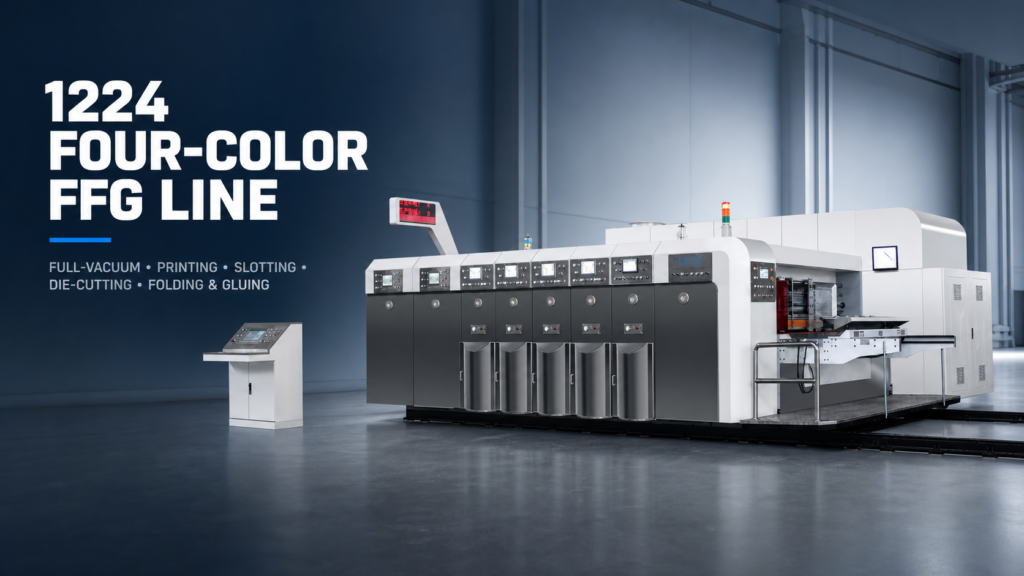
For many corrugated box plants, the real production bottleneck is not printing speed alone. It is the repeated stacking, transferring, re-feeding and re-aligning between printing, slotting, die-cutting, folding and gluing. The BONXI 1224 four-color full-vacuum down-fold FFG line is designed to connect these stages into one controlled flow, helping manufacturers reduce manual handling, setup waste and quality variation.
The customer problem: output is lost between separate processes
A plant may own a fast printer and a capable folder gluer, yet still miss delivery targets because finished sheets wait between machines. Each transfer adds labor, floor-space demand and another chance for warped board, poor alignment or mixed batches to interrupt production. Frequent order changes can also consume sheets during setup before saleable cartons begin to leave the line.
- Too much manual handling: separate machines require stacking, transport and re-feeding between processes.
- Unstable feeding on curved board: conventional transport can allow sheets to shift, especially at higher speed.
- Long changeovers: manual position and gap adjustments increase downtime and setup scrap.
- Registration and folding variation: every disconnected stage introduces another alignment point.
- Ink and cleaning losses: slow recovery and cleaning routines reduce available production time.
How the 1224 full-vacuum FFG line addresses these bottlenecks
1. Full-vacuum transport keeps the board under control
Vacuum transport is used through the printing section, with segmented suction width and adjustable air pressure. The operator can match suction to the sheet width, thickness and degree of curvature. This helps keep corrugated board moving smoothly through four-color printing without relying only on roller pressure, supporting more stable feeding and more consistent registration.
2. One connected flow removes repeated stacking and re-feeding
The reference FFG configuration combines feeding, four-color flexographic printing, slotting, die-cutting, gluing, down-folding, correction, counting and output. Connecting these processes reduces work-in-process between machines and makes production easier to schedule. Automatic glue circulation and digital counting further reduce operator intervention at the delivery end.
3. Faster changeovers reduce setup time and paper waste
PLC control, touchscreens, automatic zero return and one-key setup allow the operator to enter carton length, width and board thickness so motorized positions and gaps can adjust together. For typical cartons, the printing-machine specification indicates that automatic zeroing can bring the job into position with approximately one to two trial sheets. Actual setup waste will depend on the artwork, board and operator standard, but the objective is clear: fewer sheets used only to find the correct position.
4. Built-in ink recovery and cleaning shorten non-production time
The enclosed ink circulation system is designed to reduce ink loss. Computer-controlled ink recovery returns residual ink from the pipelines, while the specified roller-cleaning cycle is approximately 3-5 minutes. Automatic anilox lift and continued roller rotation help prevent ink from drying when feeding stops.
How much production capacity can it add?
The correct answer depends on carton size, board quality, print coverage, order length, changeover frequency, operator practice and downstream packing. It is important to separate rated speed from stable economic production speed.
- The referenced 1224 printing module lists a maximum mechanical speed of 230 sheets/min.
- Its recommended economic working speed is 150-180 sheets/min, equal to a nominal flow of 9,000-10,800 sheets per hour before planned stops and efficiency losses.
- The 1224 FFG configuration lists a reference maximum line speed of 250 pcs/min. The complete line will run at the speed proven for the current carton and its slowest active process.
Illustrative comparison: if a plant currently averages 60 cartons/min after transfers, re-feeding and restarts, reaching 150 cartons/min in a connected flow would increase nominal throughput from 3,600 to 9,000 cartons per hour. That is 2.5 times the previous flow, or a 150% increase. This example is a planning calculation, not a guaranteed result. A reliable forecast should use your actual current output, product mix, available production time and factory-acceptance test data.
The biggest gain often comes from combining higher running speed with fewer handoffs, fewer restarts and less setup scrap.
Reference specifications for the 1224 configuration
| Item | Reference specification |
|---|---|
| Model | 1224 four-color full-vacuum FFG line |
| Maximum working size | 1200 x 2400 mm |
| Minimum feed size | Printing section: 320 x 650 mm; FFG reference: 280 x 650 mm |
| Suitable corrugated board thickness | 2-11 mm for the FFG reference; printing section specified up to 12 mm |
| Printing registration | Up to +/-0.5 mm for multi-color registration under specified conditions |
| Slotting / die-cutting accuracy | +/-1.0 mm reference |
| Folding and gluing accuracy | +/-1.5 mm reference |
| Maximum slotting depth | 280 mm on the FFG reference configuration |
| Board types | Three- and five-layer corrugated board; A, B, C, E and F flute combinations within the agreed specification |
Final dimensions, speed and configuration should be confirmed against the customer’s carton drawings, flute profile, board grade and required print result before production.
Which factories benefit most from this line?
- Plants running medium or long orders that lose time between separate converting machines.
- Manufacturers needing up to four-color flexographic printing with inline slotting or die-cutting.
- Factories experiencing registration variation caused by curved or unstable corrugated sheets.
- Operations seeking faster repeat-order setup and lower trial-sheet consumption.
- Teams that want counting, stacking and finished-carton output integrated into the main production flow.
What BONXI needs to calculate your realistic output
To recommend the correct configuration and estimate net capacity, provide your maximum and minimum carton sizes, flute and board thickness, number of print colors, ink coverage, typical order quantities, current average output, shift hours and available floor space. BONXI can then compare the machine specification with your actual production mix instead of relying on a single headline speed.